Fertile days
Hello everyone, back here to write a new article that I think may interest all of you who are looking for a baby or, even, for those who, for now, wish to avoid it with natural methods (although you have to consider that it is a method without guarantees).
Today I am going to talk to you about the importance of knowing the fertile days and everything about ovulation, the most common ovulation symptoms, and ovulation tests.

When do we enter the fertile days?
Statistically, few couples conceive on the first attempt; we are talking about approximately 25%. 60% of couples take nine months to get pregnant. That is why it is very important not to get stressed if it takes time to achieve it; stress can negatively influence the attempt.
When looking for a child, it is very helpful to understand how the monthly cycle works. The menstrual cycle begins on the first day of the period and ends on the first day of the next menstruation. A complete cycle usually lasts an average of 28 days, although it can vary in some women.
During the period, after our body sheds the endometrium (the tissue and blood that forms the uterine lining), usually one of the follicles in our ovaries begins to mature and will be released around the middle of the cycle. This is what we call ovulation. Once the egg is released around day 14, we will be in the woman’s fertile days.
Ovulation occurs when the egg, under the influence of hormones, is released from the follicle. It then passes into the tube, traversing the surface of the ovary in search of a sperm to fertilize it. Considering what we have seen so far and, also, that sperm can survive inside up to 5 days (depending on its quality), the fertility range covers from the five days prior to ovulation until 12 to 24 hours after it.
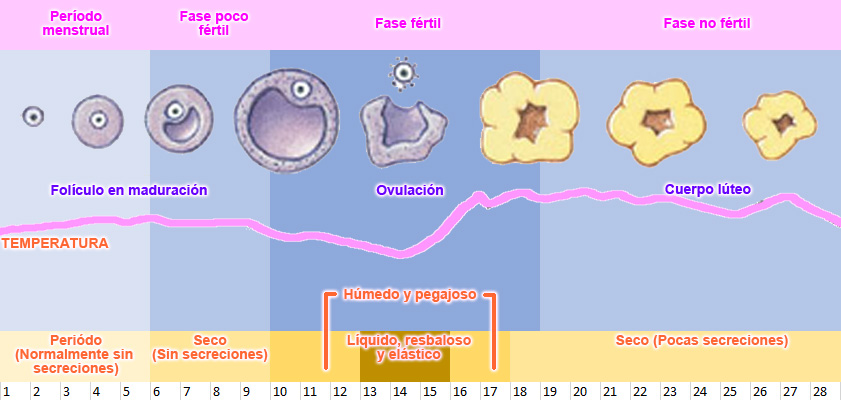
A question we often ask is “if we control our ovulation, guaranteed pregnancy? ” We can assert that no Knowing exactly when you ovulate DOES NOT guarantee that you will become pregnant if you have intercourse with your partner; many other factors come into play, but it greatly increases the chances. Here is a chart that summarizes everything I have explained so far. The numbers below represent the first day of menstruation and show the development of the egg and the evolution of temperature and secretions.
How to calculate the ovulation date?
Therefore, in a normal menstrual cycle and considering possible margins of error, we can assume that from the tenth day after the first day of the period, we would enter the fertile period, which will last until the nineteenth, with the peak period being the days of ovulation. That is when you should enjoy a lot of relaxed sex with your partner and put aside the anxiety that may arise from trying for some time.
Start date of the last period + 10 days: The fertile period starts. Start date of the last period + 19 days: The fertile period ends.
(In the next few days I will add an ovulation calculator right here that is being developed)
Ovulation symptoms
Many women do not notice or are not aware of ovulation symptoms. I am one of those who do. These symptoms are generally as follows: Lower abdominal pain: it occurs during ovulation, also known as mittleschmerz (from the German middle pain). This pain, a sharp pain on one side of the lower abdomen, occurs when the egg is released in the ovary. The basal body temperature increases : You can measure your basal temperature every day upon waking up. The days before ovulation, there is a drop in temperature that goes up after ovulation. Cervical mucus: When the fertile days begin, we start to produce secretions that become more liquid and elastic at the most fertile moment.
How does the ovulation test work?
Pregnancy tests, although they are “super effective,” are somewhat expensive and, from my point of view, make sex a bit scientific and obligatory, like “today it’s time.” Maybe at the beginning of looking for a baby, it is easier to try to calculate the approximate ovulation date with the steps indicated earlier or guide yourself by the sensations and symptoms that I will comment on later. Personally, I would recommend ovulation tests in cases where periods are very irregular or when you have been trying for a long time (more than 12 months), so you can check that you are not miscalculating the possible ovulation date, or if you don’t perceive the symptoms clearly.

And, how does the ovulation test work? Ovulation tests, also called ovulation kits or LH kits , are based on the LH hormone, which is one of the hormones involved in the follicle’s rupture process and, therefore, causing the egg to be expelled. Although it should be considered that there are illnesses that can alter this hormone, generally speaking, these ovulation kits are reliable at 99%.
How to use an ovulation test?
To use the ovulation test, it is very important to follow the instructions that come with the device. However, it essentially involves performing a test each day, starting near the day when we believe ovulation will occur. Doing it during non-fertile days might result in a substantial waste of money, especially if we have to repeat it for several months. Doing the test between 10 a.m. and 8 p.m. should work correctly, but it is advisable to do it always at the same time.
Negative ovulation test
When the ovulation test is negative , do not get discouraged; you will simply have to perform a new test the following day. If we have gone too many days without a positive or if we get our period, we will wait for the next period, perhaps starting the first test date a bit earlier in case we are calculating it incorrectly. For my part, the times I used it, I would start on the tenth day after the first day of my last period. If it repeats after several months, we should consult with a gynecologist to determine what the problem is.
Positive ovulation test
When the ovulation test is positive , it means that ovulation will occur within the next 12 to 36 hours; therefore, you can now have sex to your heart’s content, enjoying every moment with your partner. I insist, leaving behind all worries, and at least several times during the next 4 days. And remember, you won’t need to take a test again until the next period if you haven’t been lucky.
To conclude, just remember that the best option is to practice regular sex, without stress, without hurry, with love, with desire. And on my part, nothing more. If you are looking for a baby, lots of encouragement and good luck. Remember to take our free online pregnancy test when the time comes ;)