Buy a pregnancy test online: a guide to price and reliability
Hello girls, nowadays it’s really easy to find a place to buy a pregnancy test. You can get one at almost any pharmacy (there’s one on every corner, even open 24 hours), at para-pharmacies, at large stores or online. But why buy a pregnancy test online?
I’m only going to give you one reason, but I think it’s the one that carries the most weight: “discretion” ❤️.

So yes, the reason I recommend buying a pregnancy test online, especially for future mums who are actively trying, is the discretion it gives you. I’m one of those who believes that the whole trying-for-a-baby thing should stay within the intimacy of the couple or, without widening the circle too much, within the closest family. We all know that some couples take longer to conceive, and it’s no fun having people ask you about it every two minutes — especially when you’ve been trying for a while.
Why buy your pregnancy test online?
If you buy the test at your local pharmacy, you’re already opening the door to rumours, and it’s even worse if you buy it at the supermarket. You can always go to a pharmacy where nobody knows you and that’s far from your area, but why go to all that trouble when you can do it without leaving home?
The advantages of buying online are clear:
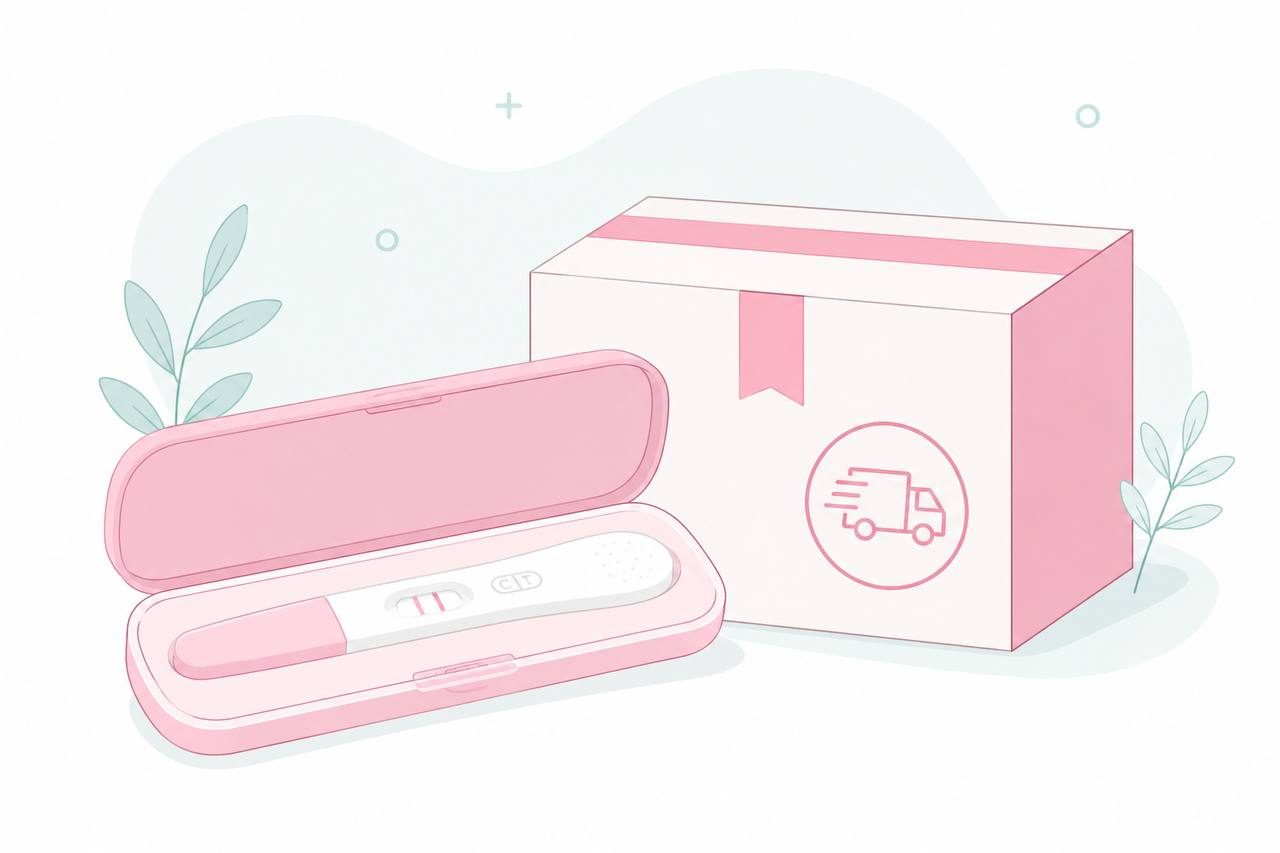
- Total discretion: the parcel arrives at your door in neutral packaging and nobody needs to know.
- Convenience: you do it in a couple of minutes, no trips and no queues.
- Compare prices: you can see several brands and formats side by side and pick the best value for money.
- More options: test strips, digital tests, multi-packs for anyone who’s actively trying.
That isn’t to say buying at a physical pharmacy is a bad idea — it isn’t. If you go to one that isn’t in your usual neighbourhood and that gives you peace of mind, go ahead. The important thing is to choose a test from a recognised brand, within its expiry date.
What to look for when buying a pregnancy test
One of the main features to pay attention to is the sensitivity of the test in detecting the hormone, shown as a value like XX mIU/ml. This tells you the amount of HCG hormone per millilitre of urine that the test can detect: the smaller the number, the more sensitive the test, and therefore you can take it a few days before your period is due. If the test has low sensitivity (higher values, like 25 mIU/ml), it’s better to wait until your period is late to avoid a negative result and needless worry.
Other things worth keeping in mind:
- Format and ease of use: it should be easy to use and to read. Clearblue is well known for how easy its format is to handle.
- Type of test: test strips are the cheapest; midstream tests (cassette or stream) are handy; digital tests show the result on a small screen and can even give you an approximate week.
- Expiry date and seal: always check the expiry date and that the packaging arrives intact.
- Known brand and references: avoid unknown brands with no instructions; a reliable test is usually one backed by a reputable brand.
If you’re not sure when to take the test or how to read the result, I recommend reading our article on how pregnancy tests work first, where I explain everything step by step.
How much does a pregnancy test cost?
Lately I’ve had many readers asking me how much a pregnancy test costs. The truth is that you read me from all over the world, and the price of a test in Spain is different from the price of one in Bolivia, Chile or Panama. Even within the same country you’ll find very different amounts: the price in a big city is usually not the same as the price in a rural area.
As a general guide:
- At a physical pharmacy: a test from a recognised brand usually costs between 2 € and 6 € per unit. They’re often sold in packs of several units and, sometimes, together with ovulation tests.
- Online: prices are usually competitive and often lower per unit when you buy in packs (test strips for less than 1 € a unit), although you have to add the shipping cost if the order is small.
- Brand to brand: the brand and the sensitivity make the difference. A digital test has a screen and, on some models, a week indicator, so it’s usually more expensive than a simple test strip.
Since the reliability is the same across tests from any serious brand (they all detect the HCG hormone), your choice comes down to your budget and which format is easiest for you. My advice: if you’re actively trying and will use several, a pack of test strips is far more economical.
Where to buy a pregnancy test online reliably
Before you hit “buy”, keep these tips in mind so you don’t get any surprises:
- Choose trusted shops: online pharmacies (online para-pharmacies), large retailers with customer support and discreet shipping, or the official website of a well-known brand.
- Check the seller’s reputation: look at reviews and, above all, make sure it’s a real business with a physical address and contact details.
- Be wary of too-good offers from unknown brands with no instructions leaflet: a test has to be used properly to be read properly.
- Check the shipping: that it’s discreet (neutral packaging) and that delivery times are clearly stated.
And one important note: you don’t always have to spend money. If you’re not sure whether you’re pregnant, you can take our free online pregnancy test to get a sense of your symptoms while you decide whether it’s time to buy a test. And if you fancy a bit of fun in the meantime, try your luck with our fun fingerprint pregnancy test game: it’s only a game, not a real test.
Which pregnancy test should you choose?
- If you’re actively trying and will use several: a pack of test strips is the most cost-effective option, so you can repeat without it costing you much.
- If you want the easiest to read: a midstream test from a well-known brand (like Clearblue) gives you a clear result in a few minutes.
- If you want more on-screen detail: a digital test can show your approximate week of pregnancy, although it doesn’t replace a blood test or an ultrasound.
- If you only test occasionally: there’s no need to splash out on big packs; a 10 mIU/ml test with a good format is enough.
Frequently asked questions about buying a pregnancy test online
Are tests bought online as reliable as those from a physical pharmacy? Yes, as long as the test is from a recognised brand and within its expiry date. Reliability doesn’t depend on where you buy it, but on the quality of the test and on doing it properly.
How much does a pregnancy test cost? At a pharmacy it usually costs between 2 € and 6 € per unit for a recognised brand. Online, if you buy in packs (for example, test strips), you can pay less than 1 € per unit, though you need to add shipping.
Is it better to buy test strips or a digital test? It depends. Strips are much cheaper and just as reliable; a digital test only adds reading convenience and, on some models, a week reading. If you’re going to repeat the test, strips are the most economical choice.
Can I take the test before my period is due? Yes, but preferably with a high-sensitivity test (10 mIU/ml). And remember that a negative result before your period isn’t 100% reliable: it’s best to repeat the test with your first morning urine on the day your period is late or afterwards.
What exactly is mIU/ml? It’s the test’s sensitivity: the minimum amount of HCG hormone it needs to detect per millilitre of urine. A 10 mIU/ml test is more sensitive than a 25 mIU/ml one.
Can I find out whether I’m pregnant without buying a test? You can get an idea, for example with our free online pregnancy test. But the only way to officially confirm a pregnancy at home is with an approved test.
Remember that all these tips are just information: if you have doubts about your symptoms or a result, the best person to ask is always your doctor or gynaecologist ❤️.