When to Take a Pregnancy Test: Calculator by Scenario
Calculadora: ¿cuándo hacerme el test?
Elige tu escenario y dime la fecha
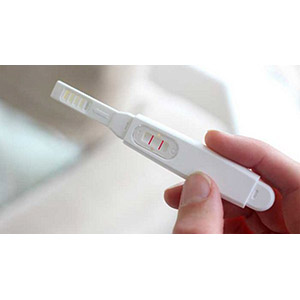
You have the test sitting on the bathroom shelf and one question on repeat: is now too early? I get this one constantly, and the honest answer is that there is no single right day — there is a right day for your situation. A test four days after sex tells you almost nothing. A test a week after your missed period tells you almost everything.
That is exactly what the calculator above is for: pick your scenario, give me the date you have, and it will show you the earliest you can test, when the result is genuinely reliable and when to retest. Below, the reasoning behind every number, so you know what you are looking at.
When to take a pregnancy test: what it actually depends on
Everything comes down to one hormone: hCG. It is not produced when sperm meets egg. It is produced when the embryo implants in the uterus, which happens 6 to 12 days after ovulation. From there it doubles roughly every 48 hours, and a urine test needs it to reach a certain level in your urine before it can see it.
So the date you should test depends on three things:
- When you ovulated — not when you had sex. Sperm can survive up to 5 days in your body waiting for the egg, so fertilisation is often later than the date in your head.
- When the embryo implanted — every pregnancy is a few days off from the textbook timeline.
- How sensitive your test is — 10 mIU/ml picks up a lower level of hCG than 25 mIU/ml.
| Your situation | Earliest you can test (sensitive 10 mIU/ml test) | When the result is reliable | Why |
|---|---|---|---|
| You have had sex | 14 days after | 21 days after | Sperm survive up to 5 days, so ovulation may come later than you think |
| You know your ovulation day | 10 days after (10 DPO) | 14 days after (14 DPO) | That is implantation (6-12 days) plus about 4 days for hCG to reach your urine |
| Your period is late | You can test now | Day 1 of the missed period | Ovulation already happened and hCG has had time to rise |
Testing after ovulation: the day-by-day guide
If you track ovulation — with OPKs, basal body temperature or an app that is actually accurate — you can forget the calendar and count in DPO, days past ovulation. It is far more precise than counting from your period.
Here is what is happening inside you each day:
| Days past ovulation | What is happening | Likely to show on a urine test? |
|---|---|---|
| 1-5 DPO | The embryo travels down the tube, dividing | No — hCG does not exist yet |
| 6-9 DPO | Implantation window | Very unlikely; only with an ultra-sensitive test |
| 10-11 DPO | hCG is being made, but levels are low | Possible with a 10 mIU/ml test |
| 12-13 DPO | hCG is rising quickly | Likely with a sensitive or standard test |
| 14 DPO | The day your period would be due in a 28-day cycle | Yes — high accuracy |
The bit that marketing blurs: “test 6 days early” means 6 days before your period, not 6 days after ovulation, and it only holds for a minority of women. A negative at 10 DPO closes absolutely nothing.
If you want to estimate your ovulation without tracking, my piece on fertile days walks through the maths — it can turn a vague “21 days after sex” into a much tighter window.
Can you test before your missed period?
You can, but be clear about what a negative means. Early testing works when two things line up: you ovulated early and your test is sensitive. It fails when the embryo simply has not implanted yet, which is nobody’s fault and no test’s fault.
My honest rule of thumb:
- If you track ovulation, testing from 10-11 DPO with a sensitive test is reasonable. If it is negative, retest on 14 DPO before you accept it.
- If you do not track ovulation, early testing is a coin toss. You will spend money and anxiety to learn very little. Waiting until the first day of your missed period gives you a much cleaner answer.
After sex, after Plan B, and on birth control
These are the three messy scenarios that the standard “test on day one of your missed period” advice does not cover.
After sex with no contraception
Count from the sex, not from your period, and use the two milestones: 14 days for the earliest possible positive, 21 days for a result you can trust. If 21 days have passed and the test is negative, that particular encounter is very unlikely to have caused a pregnancy.
After emergency contraception
The morning-after pill works by delaying or stopping ovulation — and it can also shift your period, which is the trap. The late period you are staring at may be an effect of the pill, not a pregnancy, or the pill may have failed. Because the calendar is unreliable here, count from the sex: test at 21 days, and if the period still has not come, retest a few days later or speak to your doctor.
If you are on hormonal birth control
If you take the pill, use a patch, ring, implant or IUD and use it correctly, pregnancy is unlikely — but “unlikely” is not “impossible”, and some methods stop you having a withdrawal bleed at all, so you lose your monthly signal. If you have symptoms that worry you (nausea, breast tenderness, unusual fatigue), test now: with the pill there is no “missed period” date to wait for, so test 21 days after the sex that worries you.
10 mIU/ml vs 25 mIU/ml: what the number on the box means
Every test has a sensitivity number printed on it. It is the lowest concentration of hCG the test can detect, and lower means it can turn positive earlier.
| Sensitivity | Detects | Where you notice the difference | Who it suits |
|---|---|---|---|
| 10 mIU/ml | Very low hCG levels | Can go positive 2-4 days before a missed period | Anyone tracking ovulation who wants an early answer |
| 20-25 mIU/ml | Standard levels | From the first day of a missed period | Most people: cheaper, and fewer early false negatives |
The fine print nobody mentions: a more sensitive test does not detect implantation earlier — it just needs less hormone to react. Testing at 8 DPO with a 10-device, before the embryo has implanted, will not work: there is nothing there to detect yet. That is how early testing creates the false negatives people then panic about. If you want the technical side, my article on how pregnancy tests work covers the chemistry and the real accuracy per brand type.
Morning urine or any time of day?
The instruction on the leaflet — first urine of the morning — is not superstition. Overnight you drink nothing, so your urine is more concentrated and the same amount of hCG sits in less liquid. That matters most exactly when you are testing early or right at the limit.
- First morning urine: your best shot if you are testing before your missed period.
- Later in the day: fine if you are already several days late, because hCG levels are high by then.
- After drinking a lot of water: the worst timing. It dilutes the sample and can turn a faint positive into a negative.
If it is negative: when to retest and when to get help
A negative test taken early means one of three things: you are not pregnant, you are pregnant but hCG has not crossed the threshold yet, or you ovulated later than you assumed. In all three cases the move is the same — retest in 3 days, using your first morning urine. Two days is enough for hCG to double, which is often the difference between a line you cannot see and an obvious positive.
Go to your doctor rather than repeating test after test if you have:
- Severe one-sided lower abdominal pain, especially if it is getting worse — an ectopic pregnancy needs ruling out, and it is urgent.
- Heavy bleeding, or bleeding with pain.
- Dizziness, fainting or shoulder-tip pain along with abdominal pain.
- More than 7 days late with repeated negative tests — not an emergency, but worth a review of your cycle and hormones.
- Very irregular cycles and no clear answer — a blood hCG test gives you a number instead of a yes/no.
And if the test is positive: confirmation and follow-up belong to your doctor or midwife. That is when scans, folic acid and first-trimester appointments start.
While you wait, you can take our free online pregnancy test to think through your symptoms — it is a guided questionnaire, anonymous and no sign-up, meant to sit alongside the pharmacist’s test rather than replace it. And if you fancy a bit of fun, try our fingerprint pregnancy game: it is just a game, not a real test.
Frequently asked questions
How soon after sex can I take a pregnancy test?
The earliest is 14 days after sex, but a reliable result comes at 21 days. If you know your ovulation day, the count is shorter: 10 days after ovulation with a sensitive test, and 14 days to trust the answer.
Can I take a pregnancy test at any time of day?
You can, but the first urine of the morning is more concentrated and picks up low hCG better. Later in the day works reasonably well if your period is already late, but avoid drinking a lot of water in the two hours before.
Is a 10 mIU/ml test better than a 25 mIU/ml one?
Not necessarily. The 10 mIU/ml test can go positive earlier, but it also produces more false negatives when used too soon. If you are waiting for your missed period, a standard 25 mIU/ml test is perfectly fine and cheaper.
What if I test negative several days after my missed period?
Retest 3 days later with your first morning urine. If it is still negative and you are more than 7 days late, see your doctor: late ovulation, a hormonal blip or another cause may be at play, and a blood hCG test settles it.
Are the “6 days early” tests accurate?
They are accurate for women who ovulated early and have high hCG, but in studies a significant share of pregnancies are not detected that soon. A negative 6 days before your period rules nothing out — retest later.
Can late ovulation delay a positive result?
Yes, and it is one of the most common reasons for a false negative. If you ovulated 4 days later than usual because of stress, travel or disrupted sleep, your hCG is 4 days behind and the test takes those extra days to react.
What if my cycles are irregular?
With irregular cycles the missed-period date is not a useful marker. Count from ovulation if you know it, or wait 21 days from the last time you had sex. If your cycles are often irregular, mention it to your doctor.
Should I repeat a positive test?
Many people do, for reassurance. A darker second line is a good sign, since hCG roughly doubles every two days. If the line gets fainter or disappears, tell your doctor.
Sources
- MedlinePlus — Pregnancy Test (lab test)
- MedlinePlus — HCG blood test
- NHS — Finding out you are pregnant
- NHS — Trying for a baby
- ACOG — Fertility awareness-based methods
- WHO — Antenatal care
- PubMed — Wilcox et al., Timing of sexual intercourse in relation to ovulation (PMID 7477165)
This article is for information only and does not replace advice from your doctor or midwife. If you have any concerns about your pregnancy, always speak to a healthcare professional ❤️.