False Positive and False Negative Pregnancy Test Explained
A home pregnancy test is very reliable, but it isn’t perfect. And when you’re waiting for the result with your heart in your throat, a line that shows up — or doesn’t — can cause the biggest scare (or the biggest hope) of the day. So I want to explain clearly what a false positive and a false negative are, the most common causes behind them, and above all how to tell the famous evaporation line apart from a real positive. Let me walk you through it.
If you haven’t tested yet and you’re just starting to look things up, I recommend my article on how pregnancy tests work. And if you already have the test in front of you and you’re unsure, keep reading — this will help.
The evaporation line vs a faint positive: how to tell them apart
If you’ve been researching this, you’ve probably heard about the evaporation line. It’s by far the most common cause of a false positive on strip and cassette tests — and the question I get asked about most.

What is it exactly? When the test dries, the evaporating liquid can leave a residue in the result window. That residue sometimes draws a colorless line (grayish or translucent) that’s easily mistaken for a second line. The key point is that it isn’t pink or blue — it has no pigment — and it usually appears after the recommended reading time (the typical “read within 3-5 minutes”).
| Evaporation line | Real positive | |
|---|---|---|
| Color | Gray, translucent or whitish — no pigment | Pink or blue, depending on the brand |
| When it shows | As the test dries, usually after 5-10 minutes | Within the reading window in the instructions (3-5 min) |
| Texture | Thin, uneven or “dotted” | Continuous and even |
| If you retest | Usually doesn’t come back | Comes back again |
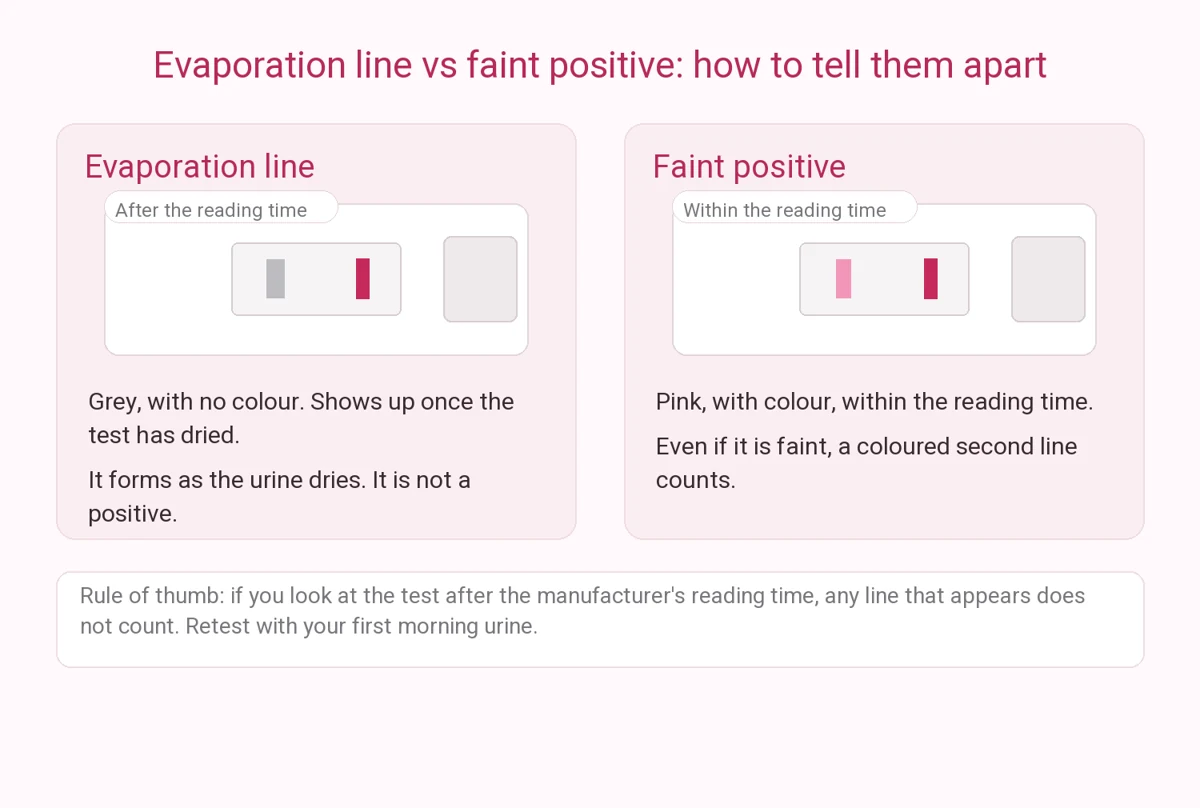 Our own diagram: what changes is the colour of the line and when you look at the test.
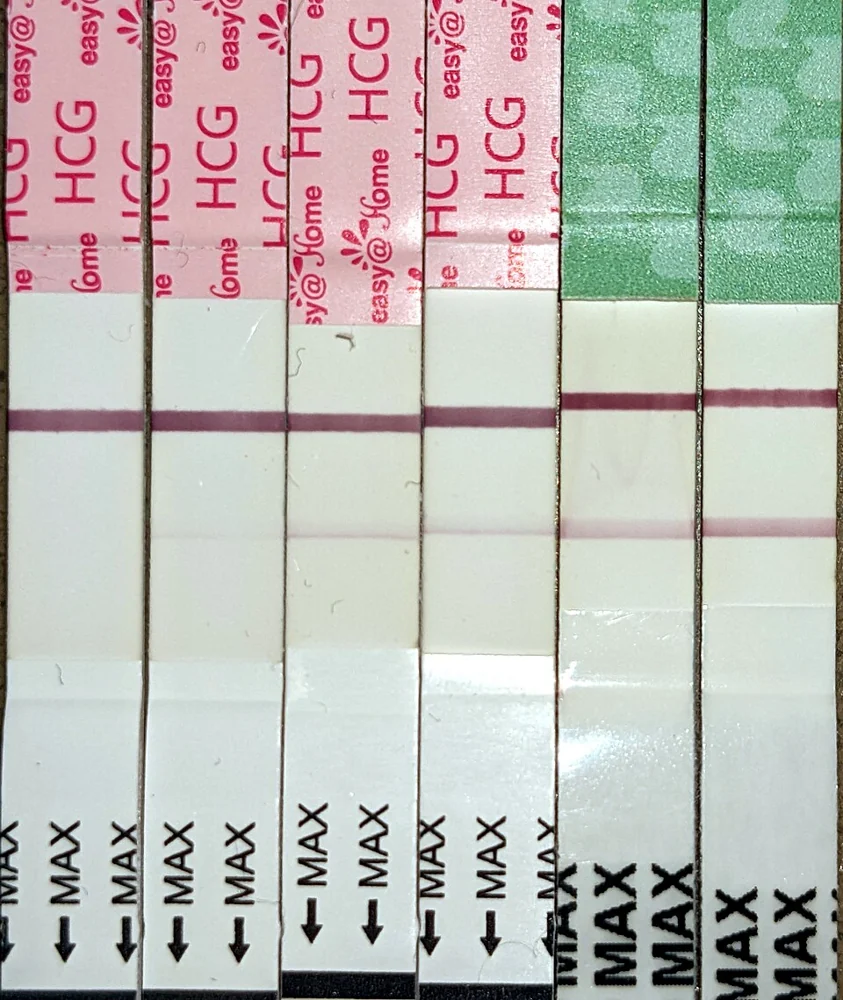 Strips taken one day after another in early pregnancy: the line darkens as hCG rises. Photo: Grendelkhan, CC BY-SA 4.0.
My usual advice: don’t hang on to the test and re-read it hours later. The reliable result is the one read within the time stated in the instructions. Past that time, any extra line is irrelevant.
Why a pregnancy test can be wrong: the short version
| What it means | Most common cause | What to do | |
|---|---|---|---|
| False positive | The test says positive but you’re not pregnant | Evaporation line (reading the test too late) | Retest within the reading window and confirm with your doctor |
| False negative | The test says negative but you are pregnant | Testing too early or very diluted urine | Wait 2-3 days and retest with your first morning urine |
Let me be clear: today’s tests are more than 99% accurate when used correctly and after your expected period date. Failures almost always come down to misuse, testing at the wrong time, or that sneaky culprit above.
In the meantime you can take our free online pregnancy test to get a sense of your symptoms. And if you fancy a bit of fun, give our fingerprint pregnancy test game a go — it’s just a game, not a real test.
Other causes of a false positive
Besides the evaporation line, there are a few uncommon but real situations that can produce a positive without pregnancy:
- Chemical pregnancy: a minimal implantation happened and produced some hCG, but the pregnancy didn’t develop. The test picks up that hCG and shows positive, although your period comes shortly after. It’s more common than people think — I go through it properly in my article on biochemical pregnancy.
- Medication containing hCG: some fertility treatments (the ones injected with hCG) can cause a positive for several days.
- Reading the test too late: we’ve covered this — that’s the evaporation line, the most typical cause.
- Perimenopause or PCOS: hormonal changes around perimenopause, and some conditions like PCOS, can occasionally interfere with a result. This is uncommon and worth checking with a doctor rather than guessing.
- Rare medical conditions: certain tumors that produce hCG. This is very uncommon.
Either way, if you get a positive and then a negative, or a negative with symptoms, the sensible thing is to repeat the test and talk to your doctor. You can learn more about how the hormone behaves in my articles on the Clearblue digital test and the One Step test.
False negative: how common is it and what causes it
Here I’ll be honest with you: a false negative is much more common than a false positive, and it almost always comes down to timing or technique. As for how common: there’s no single number that fits every case, but the pattern is clear — done properly, after your period is late, with first morning urine, the chance is small (accuracy goes above 99%). The chance climbs fast when you test too early.
What’s behind it, scenario by scenario:
Testing before your period is late
The most frequent reason. hCG hasn’t reached the test’s detection threshold yet, so a negative at this point doesn’t mean much. If you test before your missed period, the risk of a false negative rises a lot.
Very diluted urine, or testing in the afternoon
If you drank a lot of water and tested mid-afternoon, hCG concentration drops and the test may not pick it up. That’s why the first morning urine is recommended.
A 25 mIU/ml test instead of a 10 mIU/ml one
Sensitivity matters: tests with 25 mIU/ml detect less hormone than those with 10 mIU/ml. The lower the number, the earlier it detects. If you’re keen to know as early as possible, this difference explains a lot.
Two smaller things can add to it: reading it in the first minute (the line may not have developed yet) and using an expired or poorly stored test. If it came back negative but you have symptoms or a clear delay, my recommendation is to wait 2-3 days and repeat — hCG doubles every 48 hours, so in a few days the answer will be much clearer. You can use the how many weeks of pregnancy am I calculator to get an idea of where you stand, or read my guide on how many days after a missed period to test.
Positive then negative: what it means
This one scares people a lot, and I see it constantly: you get a positive (or a faint line), and the next day — sometimes the same day — another test is negative.
- You read the first test too late and that “line” was an evaporation line. By far the most common scenario.
- You used tests of different brands or sensitivities: a 25 mIU/ml test can be negative while a 10 mIU/ml test shows positive on the same urine.
- The second sample was more diluted, if you took it in the afternoon after drinking.
- Chemical pregnancy: hCG rose a little, the test caught it, then the hormone started to fall. My article on the faint positive pregnancy test covers this in detail.
The golden rule: never draw conclusions from a single test. Wait 2-3 days and repeat with your first morning urine, always reading within the window in the instructions.
Can a blood test give a false positive?
A lot of people assume “blood tests don’t get it wrong”, and the truth is a little more nuanced. A quantitative beta-hCG blood test is far more sensitive and specific than a urine test because it measures the actual hormone level — which is why it’s the most reliable confirmation test there is.
Even so, in rare cases it can read oddly: hCG medication, tumors that produce hCG, or a chemical pregnancy (the level rose but the pregnancy didn’t develop). So a “false positive on a blood test” is possible but extremely rare, and it’s always your doctor who interprets the number alongside your history and, if needed, an ultrasound. If your beta-hCG result is worrying you, I have an article explaining beta-hCG values week by week.
When to see a doctor (instead of retesting again)
Retesting once is sensible. Retesting ten times isn’t. Call your doctor or midwife if:
- You get a positive then a negative and more than 3-4 days pass without things becoming clearer.
- The test stays negative more than a week after a clear missed period.
- You have a positive with severe one-sided pain, heavy bleeding or dizziness — don’t wait a day on this one, as it can be a sign of an ectopic pregnancy.
- The uncertainty is really getting to you. For that you don’t need to wait for anything: just call and ask.
If you want your next steps laid out, my action plan after a positive test has a printable checklist. And please stay away from homemade methods with no evidence behind them, no matter how tempting they seem — I always say this, and if you want the full explanation you have my article on the bleach pregnancy test.
Frequently asked questions
How long does it take for the evaporation line to appear?
It usually appears after the 5-10 minute mark, when the test dries. That’s why you should read within the window stated in the instructions (usually 3-5 minutes). Past that time, ignore any new line.
Can it show positive if I’m not pregnant?
Yes, it’s uncommon but possible, mainly from an evaporation line, a chemical pregnancy or, in rare cases, medication containing hCG or certain illnesses. A positive should always be repeated and confirmed with a doctor.
How common is a false negative pregnancy test?
Much more common than a false positive, and it’s nearly always about testing too early or with diluted urine. Done after your period is late with first morning urine, the accuracy is over 99%, so the chance is small.
Why is the test negative if I’m pregnant?
The most common reasons are testing too early or with very diluted urine. Wait 2-3 days (hCG doubles every 48 hours) and repeat with your first morning urine.
Does the evaporation line have color?
No. It’s a grayish, translucent or whitish line with no pink or blue pigment. A real positive has color. If in doubt, repeat the test.
Can an expired test give a wrong result?
It can. An expired or poorly stored test may not work properly, most often producing a false negative. Always check the expiry date before using it.
Does a chemical pregnancy count as a false positive?
From a practical point of view, yes: the test picks up the hCG but the pregnancy doesn’t develop and your period comes. It’s more common than people think and doesn’t mean you’ll have trouble getting pregnant. Talk to your doctor if it happens to you.
Can taking a pregnancy test while breastfeeding affect the result?
Usually no — breastfeeding itself doesn’t create hCG. But breastfeeding can make your cycles irregular, so it’s often harder to know when your period is due, and testing at the wrong time is then more likely to give a false negative. If in doubt, give it a few more days and retest.
Sources
- ACOG — Prenatal care
- MedlinePlus — Pregnancy test (urine)
- NHS — Finding out you are pregnant
- NHS — Miscarriage
- ACOG — Early pregnancy loss
- WHO — Maternal health
- PubMed — Sensitivity of urine hCG tests (PMID 15737961)
Remember that this article is for information only. If you have an unclear result, worrying symptoms, or want to confirm a positive, the best decision is always to see your doctor or gynecologist, who will tell you which tests are appropriate and support you through this very special moment ❤️.

![Online gestogram: pregnancy wheel and due date [Calculator]](/img/300_Test-de-embarazo-Online-Gestograma.jpg)