Online gestogram: pregnancy wheel and due date [Calculator]
Gestograma online
Introduce el primer día de tu última regla
Let me tell you something: when I went to my first appointment with the gynaecologist, I was intrigued by that cardboard calendar that spun around while she asked me when my last period had started. I soon found out it was a gestogram, also called a pregnancy wheel or gestational disc. Today, with the online gestogram right here at the top, you can do the same as that cardboard wheel: find out which week of pregnancy you’re in and when your baby might be born, without printing anything.
What is a gestogram or pregnancy wheel?
A gestogram is a circular chart used to track pregnancy week by week. It has two concentric discs: an outer one with the calendar (the 12 months) and an inner one with the pregnancy weeks and, on some models, the baby’s growth data.
By aligning the arrow on the inner disc with the first day of your last period (your LMP), the gestogram shows you at a glance:
- Your current pregnancy week
- Your estimated due date (EDD)
- The trimester you’re in
- Sometimes, baby measurements like biparietal diameter, femur length, weight or length
It’s basically a manual pregnancy week calculator, but you spin a disc instead of doing the math.
How do you use the online gestogram?
Our online gestogram works just like the cardboard one, but without moving discs:
- Enter the first day of your last period (LMP) in the field above
- Press Calculate
- The inner disc will rotate to align your LMP, and you’ll see your pregnancy week, estimated due date and trimester in the centre
The pink arrow on the wheel marks your LMP and the dark red line marks today on the calendar, so you can see exactly where you are in your pregnancy.
⚠️ Remember: the online gestogram is an estimate. Only a doctor can confirm your due date with an ultrasound. If you have any concerns about your pregnancy, always talk to your gynaecologist. ❤️
What is the gestogram for?
Besides knowing your week and due date, the gestogram helps you:
- Keep track of your pregnancy without relying on an app
- Know your trimester and what to expect at each stage
- Check the baby’s development on models that include fetal measurements
- Understand your gynaecologist when they give you the gestational age at the ultrasound
Just found out you’re pregnant and don’t know where to start? I recommend reading about early pregnancy symptoms and how an online pregnancy test works to get the full picture.
How do I make my own paper gestogram?
If you prefer a physical one to carry around, it’s very simple:
- Download the gestogram by clicking on the image below
- Print the two discs separately, ideally on cardstock or thick paper
- Cut out the discs carefully, keeping the tip of the arrow intact
- Join the two discs in the centre with a brad or small fastener, so they spin with a little resistance
- Align the arrow with your LMP date and done! The weeks are on the inner disc (alternating dark and light pink) and the calendar on the outside
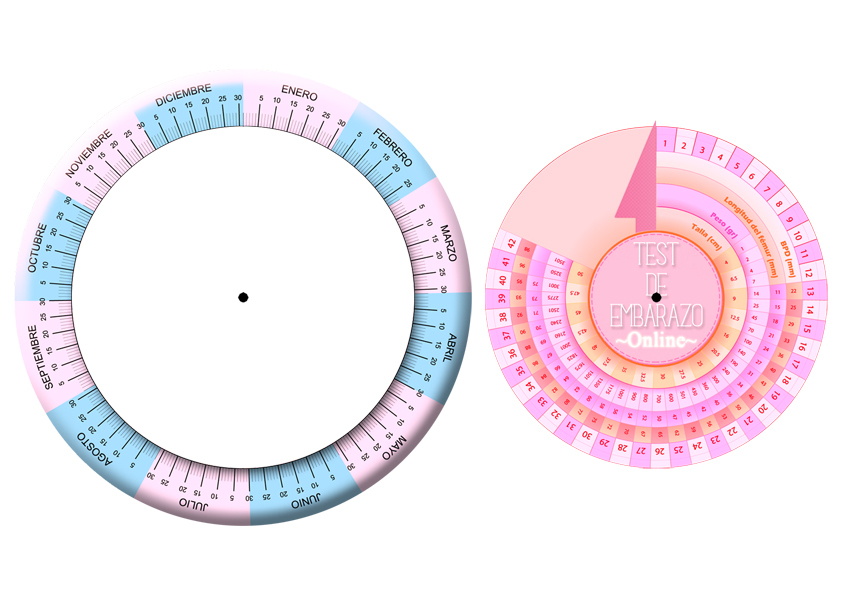
With week 40 of the inner disc aligned with the outer calendar, you’ll see your estimated due date. And without moving anything, look up today’s date on the calendar to find your current week.
Frequently asked questions about the gestogram
What is a pregnancy wheel?
It’s the same as a gestogram: a disc with two concentric circles (calendar + pregnancy weeks) used to calculate gestational age and the estimated due date. It’s a classic tool in maternity wards and gynaecology clinics, although the digital version is becoming more common.
Is the online gestogram free?
Yes, completely free and with no downloads: just enter your last period date and get your week, trimester and estimated due date instantly.
How does the gestogram calculate the due date?
The gestogram uses Naegele’s rule: it adds 280 days (40 weeks of gestation) to the first day of your last period. It’s the same calculation your gynaecologist uses, though the first-trimester ultrasound can refine the date.
When should I use the gestogram?
As soon as you know you’re pregnant or your period is late. With just the first day of your last period, the gestogram tells you your week and when your baby might arrive.
Is the gestogram reliable for the due date?
The gestogram is approximate: it assumes a 28-day cycle and an average 40-week pregnancy. Only a small percentage of babies are born exactly on the due date. The first-trimester ultrasound is the most reliable method for gestational age.
Do I need anything special to print the gestogram?
No, any printer works. I do recommend cardstock or thick paper so the discs survive daily use, and a brad or small fastener to hold them together.
Note: the fetal biometric data (weight, length, femur) included in some gestograms are based on average statistical values from a given population. They are indicative, never absolute values. Any questions about your pregnancy should be discussed with your gynaecologist, who is the best person to guide you through your baby’s development.