Pregnancy week 27: baby weight in kg, size and movement
Twenty-seven weeks is the week the numbers finally feel real. Your baby is no longer measured in grams you have to squint at — they’re closing in on a kilo, they’re roughly the length of your forearm, and they have started doing something you’d recognise as sleeping and waking. This is also the last full week of your second trimester, which means you’re about to cross into the stretch that everyone warns you about ❤️.
Coming from week 26? That one was about eyes, position and a bump that got tight by evening. This week I want to answer the question people actually type at 2 a.m.: how much does my baby weigh in kg, and is that enough if something happens now? All the weeks live in pregnancy week by week.
Your baby at 27 weeks: weight in kg, length and what changed
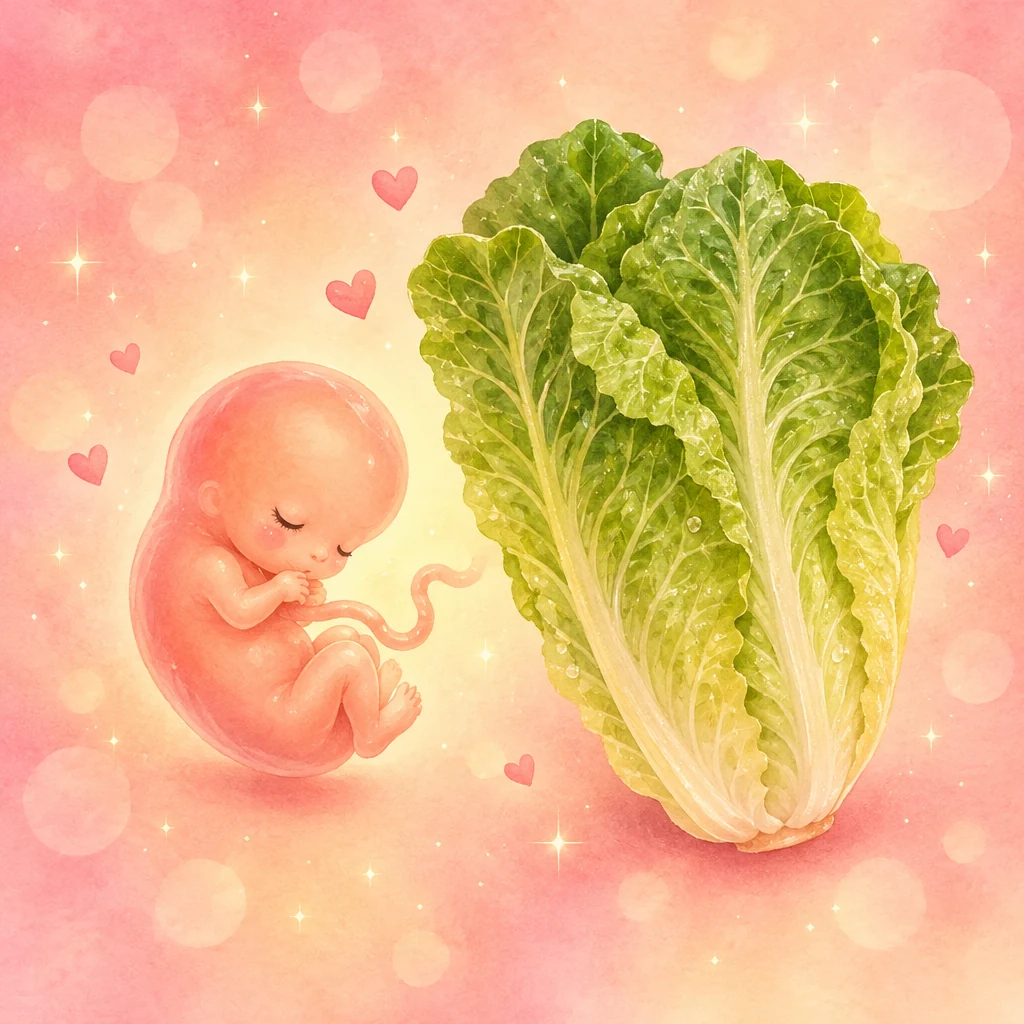
At 27 weeks pregnant your baby weighs roughly 0.85-0.9 kg and measures about 36-37 cm from head to heel. If you’ve been tracking the fruit comparisons, this is the head of cabbage week — compact, heavy for its size, and surprisingly solid when it presses into your ribs.
| Week | Length | Weight |
|---|---|---|
| 25 | 34-35 cm | 0.66-0.70 kg |
| 26 | 35-36 cm | 0.75-0.80 kg |
| 27 | 36-37 cm | 0.85-0.90 kg |
| 28 | 37-38 cm | 1.00-1.10 kg |
Two things are worth saying about these numbers. First, they’re averages — a baby on the 10th centile and a baby on the 90th can differ by 150 g and both be perfectly healthy. Second, the growth rate matters more than any single scan: from here to birth your baby gains roughly 150-200 g a week, and that is exactly the curve your midwife is looking at when she plots the measurements.
Is 27 weeks viable?
Yes — and this is the part I want to be careful with, because it’s frightening and often badly explained. At 27 weeks a baby can survive outside the womb with neonatal intensive care. In countries with full NICU provision, most babies born at this gestation do survive. What that sentence hides is the work involved: breathing support, tube feeding, time in an incubator, and a higher chance of developmental follow-up later.
So if you go into preterm labour now, the plan is not panic — it’s buying days. Steroids to mature the lungs, medication to slow contractions, magnesium for brain protection in some units, and delivery in a hospital with a NICU rather than the nearest one.
27 weeks pregnant in months and trimesters
Quick answer: 27 weeks is seven months, and you are still in the second trimester — but only just. The third trimester starts at 28 weeks, so this is the final week of the middle stretch.
| Weeks | Month | Trimester |
|---|---|---|
| 22-26 | Sixth month | Second |
| 27-31 | Seventh month | Third from week 28 |
| 32-35 | Eighth month | Third |
| 36-40 | Ninth month | Third |
In days, 27 weeks is 189 days, and if your due date is accurate you have about 91 days — 13 weeks — to go. From conception the baby is around 25 weeks old, because pregnancy dates run from the first day of your last period, not from the day you conceived. If that arithmetic is the bit that keeps confusing you, the gestogram does it for you, and the weeks calculator tells you exactly where you are today.
What your baby is doing in there: sleep, dreams and brain folds
Here’s the change that makes this week feel different. Until now your baby moved in a fairly random pattern. From around 27 weeks, movement starts to organise into sleep and wake cycles — periods of active sleep (the equivalent of REM, with rapid eye movements and twitches) alternating with quiet sleep.
That means three very practical things:
- Some quiet days are just sleep. A baby in a deep sleep phase can go a couple of hours with barely a nudge.
- The hiccups have a purpose. That rhythmic tapping is the diaphragm practising. It’s normal, it can last ten minutes, and it doesn’t mean anything is wrong.
- The brain is folding. The grooves and ridges that give the brain its walnut look are forming fast now, which is what allows it to start regulating breathing, temperature and sleep itself.
Can babies dream at 27 weeks?
Honestly: nobody knows. What we do know is that the brain shows REM-type activity, and REM is the stage in which adults dream. Whether there’s anything experience-like happening in there is a question science hasn’t answered. What you can be sure of is that your baby responds to your voice, to music, to a door slamming, and to light on your belly.
Baby position at 27 weeks: head down, breech or sideways?
Almost every scan report around now says something about presentation, and almost every parent reads it as a verdict. It isn’t. At 27 weeks there is still plenty of room, and most babies change position several times a day. Head-down (cephalic) is what you want eventually; breech and transverse are completely normal findings now.
The position usually settles between 32 and 36 weeks, and in first pregnancies sometimes later than that. If your baby is breech at 27 weeks, nothing needs doing. If they’re still breech at 36, your team will discuss options — an external cephalic version, or planning a caesarean — and that conversation is still nine weeks away.
One myth worth killing: the shape of your bump doesn’t tell you the position. A high, wide, pointy or “boy-shaped” bump is about your muscles, your height and how the baby is lying on any given day, not a diagnostic sign.
Symptoms at 27 weeks: what’s new and what’s just uncomfortable
The uterus now sits around 7 cm above your navel, and that changes the geometry of everything:
- Backache, worst at the end of the day and after standing for a while.
- Leg cramps at night, especially if you’ve been on your feet.
- Heartburn and reflux — the stomach has less room and the valve is relaxed by progesterone.
- Shortness of breath when talking a lot or climbing stairs.
- Swollen ankles and fingers, more in warm weather.
- Insomnia and at least one bathroom trip per night.
- Stretch marks and itching as the skin stretches.
- Haemorrhoids, very common with the constipation of late pregnancy.
- Colostrum — a few drops of yellowish fluid from the nipple is normal from now on.
- Braxton Hicks tightenings: irregular, painless, and they stop when you change what you’re doing.
When lower abdominal pain is not just stretching
Pain low down at 27 weeks has a short list of usual suspects: round ligament pain (a sharp pull in the groin when you get up or sneeze), the sheer weight of the uterus, and Braxton Hicks. But there are three that need action rather than a hot water bottle:
- A urinary infection. In pregnancy it often doesn’t sting — it just gives low pain, pressure and constant trips to the toilet. It needs a urine test and antibiotics, because an untreated infection can ascend to the kidney.
- Preterm labour. Regular tightenings that don’t stop when you lie down, period-like back pain, a feeling of pressure downwards, or fluid leaking.
- Preeclampsia. Pain under the ribs on the right, with headache, visual changes or swelling of the hands and face. That combination is an emergency, not a symptom to monitor.
Movement: stop counting, start noticing
The advice that changed everything in maternity care is this: there is no universal number of kicks per hour. Counting to ten creates anxiety and misses the point. What matters is your baby’s own pattern — when they’re usually active, and how strong it feels.
Spend a few days noticing. Some babies are liveliest after you eat, some at night when you finally lie down, some first thing in the morning. Once you know their rhythm, the thing to watch for is a clear change from that rhythm — much less movement than usual, or a change in the strength of it, lasting hours rather than minutes.
If that happens, call your maternity unit the same day. They’ll listen to the heartbeat and usually do a scan or monitoring. Most of the time it’s fine; the reason the advice is so blunt is that the times it isn’t, hours matter.
The appointments that land around week 27
This is a busy fortnight administratively, so here’s the checklist:
- Glucose screening — the window is 24 to 28 weeks. If you haven’t had it yet, this is the week to book it.
- Whooping cough (Tdap) vaccine — offered in the third trimester in most schedules, often from 27-28 weeks, so the antibodies cross the placenta before birth.
- Anti-D injection at around 28 weeks if you’re Rh negative.
- Your next antenatal appointment — blood pressure, urine, fundal height, heartbeat.
- Birth plan and antenatal classes — worth starting now rather than at 36 weeks.
- The big purchases: car seat, crib, hospital bag.
When to call your midwife or maternity unit
Don’t wait for the next appointment if you have:
- Regular contractions every ten minutes or less that don’t ease with rest.
- Any fluid leaking from the vagina, or a feeling that something has ruptured.
- Bleeding of any amount.
- A clear reduction in movements that doesn’t recover within a few hours.
- A severe headache with swelling of hands or face, or blurred vision.
- Fever above 38 °C, or shivering.
- Pain under the ribs on the right, with nausea.
- Intense itching of hands and feet, especially at night — this needs a liver blood test.
Nobody in maternity care minds being called for nothing. That’s the job.
And if you just want to sanity-check what you’re feeling, the online pregnancy test quiz is a symptom questionnaire for fun and orientation, and the finger pregnancy test game is pure entertainment — a game, not a test.
FAQ
How many months is 27 weeks pregnant? Seven months. The seventh month runs from week 27 to week 31, and the third trimester begins at 28 weeks. In days, 27 weeks is 189.
How much does a baby weigh at 27 weeks in kg? About 0.85-0.9 kg, with a length of 36-37 cm. That’s an average — the normal range is wide and your baby’s own growth curve matters far more than the number.
Can a baby born at 27 weeks survive? Yes, with neonatal intensive care. Most babies born at this gestation survive in units with full NICU support, though many need breathing support and time in an incubator. Outcomes depend on weight, complications and the care available.
What does 27 weeks look like in fruit? A head of cabbage. The fruit comparisons are just a visual aid; the centimetres and grams are the useful part.
Is it normal for my baby to be breech at 27 weeks? Completely. Position usually settles between 32 and 36 weeks. There is nothing to correct at 27.
Should I be counting kicks? No. Count patterns, not numbers. Know when your baby is usually active, and call the same day if that pattern clearly changes.
Why does my lower belly hurt at 27 weeks? Usually round ligament pain, the weight of the uterus, or Braxton Hicks. Pain on one side, with fever, bleeding, fluid loss or regular tightenings is a different story and needs same-day assessment.
Which trimester am I in at 27 weeks? The second — and it’s the last week of it. The third trimester starts at week 28.
Every pregnancy is different, and this article is general information, not a diagnosis. If anything worries you, speak to your midwife or doctor — that’s what they’re there for ❤️.
Sources
- NHS — 27 weeks pregnant
- MedlinePlus — Fetal development
- MedlinePlus — Premature babies
- ACOG — How your fetus grows during pregnancy
- ACOG — Preterm labor and birth
- NHS — Premature labour and birth
- World Health Organization — Preterm birth
This article is for information only and does not replace advice from your midwife or doctor. If you have any concerns about your pregnancy, contact a healthcare professional ❤️.